Translate

August 23, 2022

Belgium - Texture - The Flax Museum

You will probably have to get used with me talking about textiles, be Romanian Blouses, museums, workshops, examples... cause this is my interest now. So when I've heard that there is a flax museum in Belgium, no less, I made it possible for me to visit it.

It is not close to Luxembourg (even though a two hours drive is close), but unless you are a textile passionate as myself, I don't see the point of going to the museum form Luxembourg. BUT if you go to the Belgian seaside, a detour is doable and in the process you go far away from the Brussels traffic so win-win situation, in my eyes.

To be honest, I found out recently about the existence of Belgian linen and I was as surprised about it as I was of Irish linen. Somehow in my head linen was sourced from the Baltic States, especially Lithuania. But it makes sense and it also makes me dive even deeper into the world of natural fabrics. If you know a comprehensive book about linen, please point it my way.

They say that the North Sea Region (Caen in France, going through Belgium coast and ending in Amsterdam) with it alternation of rain and sun, makes it ideal for growing flax, even more, that in 2020, 80% of the flax produced in the world came from here. They are making linen here for more than 160 years. 

So first thing first, I use "flax" and "linen" terms and I understand flax as the plant and fibre and linen the product. There are different types of linen and I think that the Belgian one is more for household consumption than for clothing, so maybe that is why it was never on my radar and judging by their prices I would say, it wouldn't be very soon. 

Now on the museum. It is in the town of Kortrijk in an old flax distribution centre, the entrance ticket is 6 euros and the visit can last from one hour to depending how enthusiastic you are about linen and textiles. The museum has three rooms on three floors, the first one is The Wonder Room and I have to say I've enjoyed that the most.

What you see today is the result of merging two collections, the flax tools and memorabilia belongs to Bert Dewilde, who started collecting them in 1960, and opened a museum in 1982. The second collection came into being because of the donations of finished products made from flax. So, Annick Dewilde put together what you can admire in the third room.

I've liked the tactile difference between fibres, I enjoyed looking through the lenses at different fabrics and admired the objects made from flax that are not at all textiles. 

The second room, the Lys Room, tells the history of the flax production in the region, it shows the heavy machinery used in the industry, you can read testimonials, see movies, is the most extensive room to visit. I've liked some of the tools used in the flax production and found the display interesting. 

The third room, The Treasury, depicts objects made out of lace, cause if you say Belgium, than the first textile that comes to one's mind is lace. If you've ever ended up in a lace museum or lace shop, the third room will look a bit poor, only a few displayed items, interesting description, I admit, but they are only a few. What I found more interesting was the movie and the legends and the explanations of scenes embroidered on lace. So if you make it there, be sure to listen to the explanations, they are in the middle of the room, you can't miss them.

The shop, on the other hand was disappointing, to me. Yes they have a lot of books about the topic of the museum, but most are in Flemish, they have some towels, but not many, and for the embroidery enthusiast they have linen threads made in China :( I found only one bobbin of Belgian linen, 9 euros, and had to have one, even though I can't use it in embroidery, but maybe I can use it in putting the whole blouse together, in sewing the blouse, maybe. 


This is from the first room, the ground floor one and this and the next picture display I confess I've liked the most. This one shows you the different fibres, natural and synthetic and you can touch the fabric resulted from those fabrics. I've touched for the first time a fabric made of wool, which was not knitted. 
In my region, in Romania, Iași, people of old times would wear blouses and not only made of wool from a certain sheep, they would spin the wool well so that the fibre was thin enough for looming. Unfortunately the craft is lost, or at least I don't know of any person making this process by hand, so to at least feel the wool fabric to me was precious. 


Next thing was seeing through microscope different fabrics. Very interesting!


Objects made from flax, this was a cocoon, which to me looked alien like, but who knows what our future holds... 


On the second floor, Ilinca liked this children's house


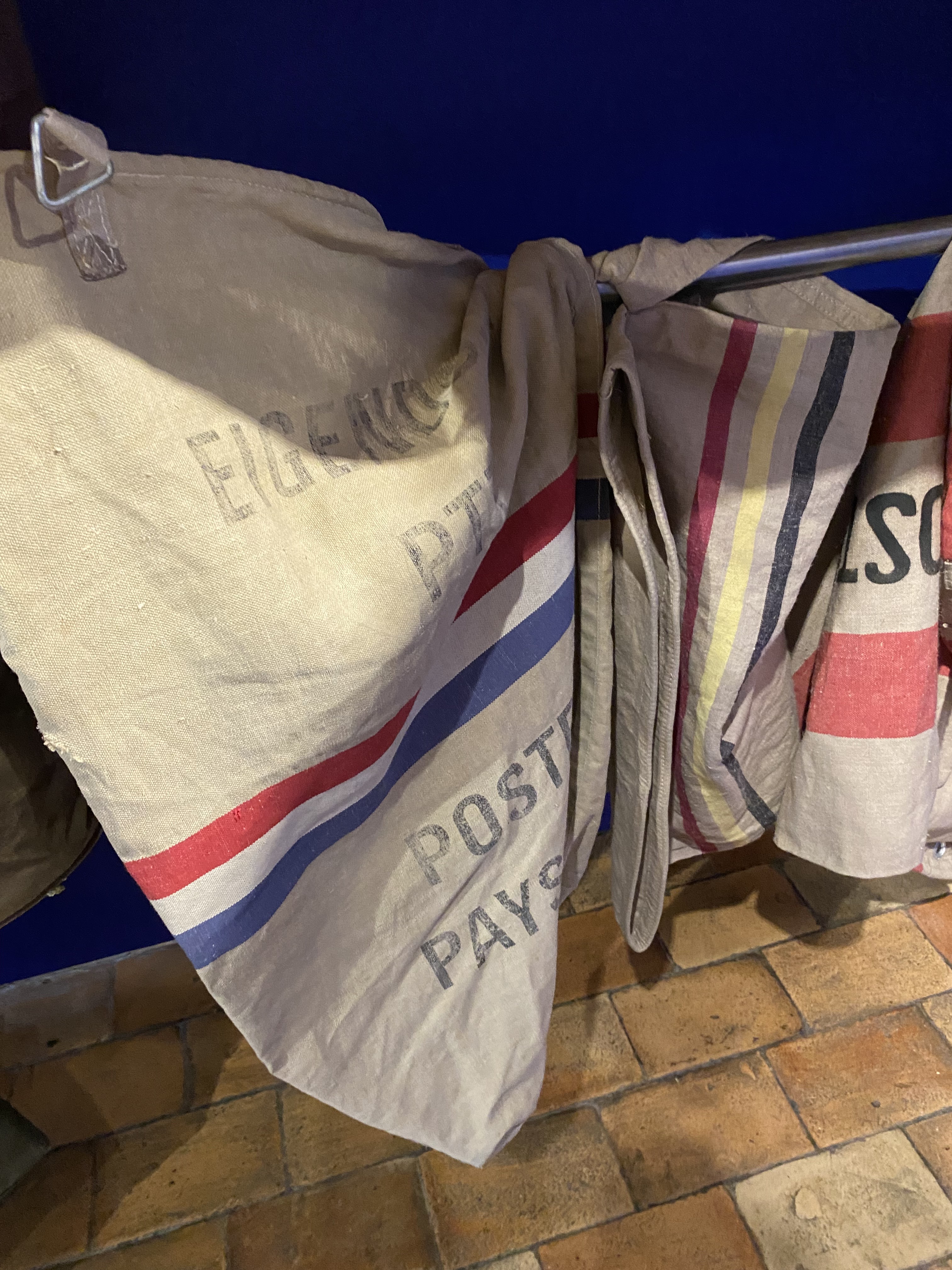
Postal bags made of flax


A belt


Lace bobbin


Spinning wheel


From the third floor


My linen bobbin, made in Belgium. They had white as well, but I plan to use it when I'll make another hemp blouse.

Normally I would say to go on my Instagram @mademoiselle.ralu but lately all the changes that the platform is putting in place are not to my liking. I don't have tone of time to spend there either, so...we'll see.

July 19, 2022

France - The village of old crafts in Meuse - Vieux Metiers Azannes Museum

I am a bit in a hurry to write this post, because only the next weekend you can visit the "museum". Also, it's not quite a museum is more of someone's home turned into a museum showcasing old crafts from the village world. Otherwise, if I've convinced you, keep an eye on their website or their social media to see the next events.

It is rather close to Luxembourg, if you go towards Verdun. So it is doable. And despite the very crowded parking, the village did not seem that crowded. Let's put it in another form, after a pandemic, I haven't felt in any way awkward. 

Also, because of the size of the place (17 hectares) and the limited number of buildings, I think that without the open days, the village would feel a bit deserted. But, during the open days, all the crafts showcased in the village are live, you can make (and buy) bread, tarts, you can see how the hats are made, how the Christmas creche is made, how textiles are made and washed, you can print stuff, you can experience a plethora of agricultural works, including beekeeping, and also discover how the people who were doing those crafts lived. 

The village was opened in 1990 and although I am old enough to remember the 90's, since then, 32 years have passed. You can read about its history here and also see the way it evolved. 

It is very child friendly and buggy friendly, from the entrance you have a place where you can get a cold water, something to eat and ice-cream and on a hot day like the one we visited the museum you don't have to worry you will not be hidrated.

The entrance fee is 16 euro, a bit much, but the prices inside are minimal (1 euro a water, 2.5 for a goffre, 1.5 for a coffee). 

I hope I've convinced you to give it a try, if not, here are a few pictures.

First craft, The Hatter 
I was watching a lady making a straw hat
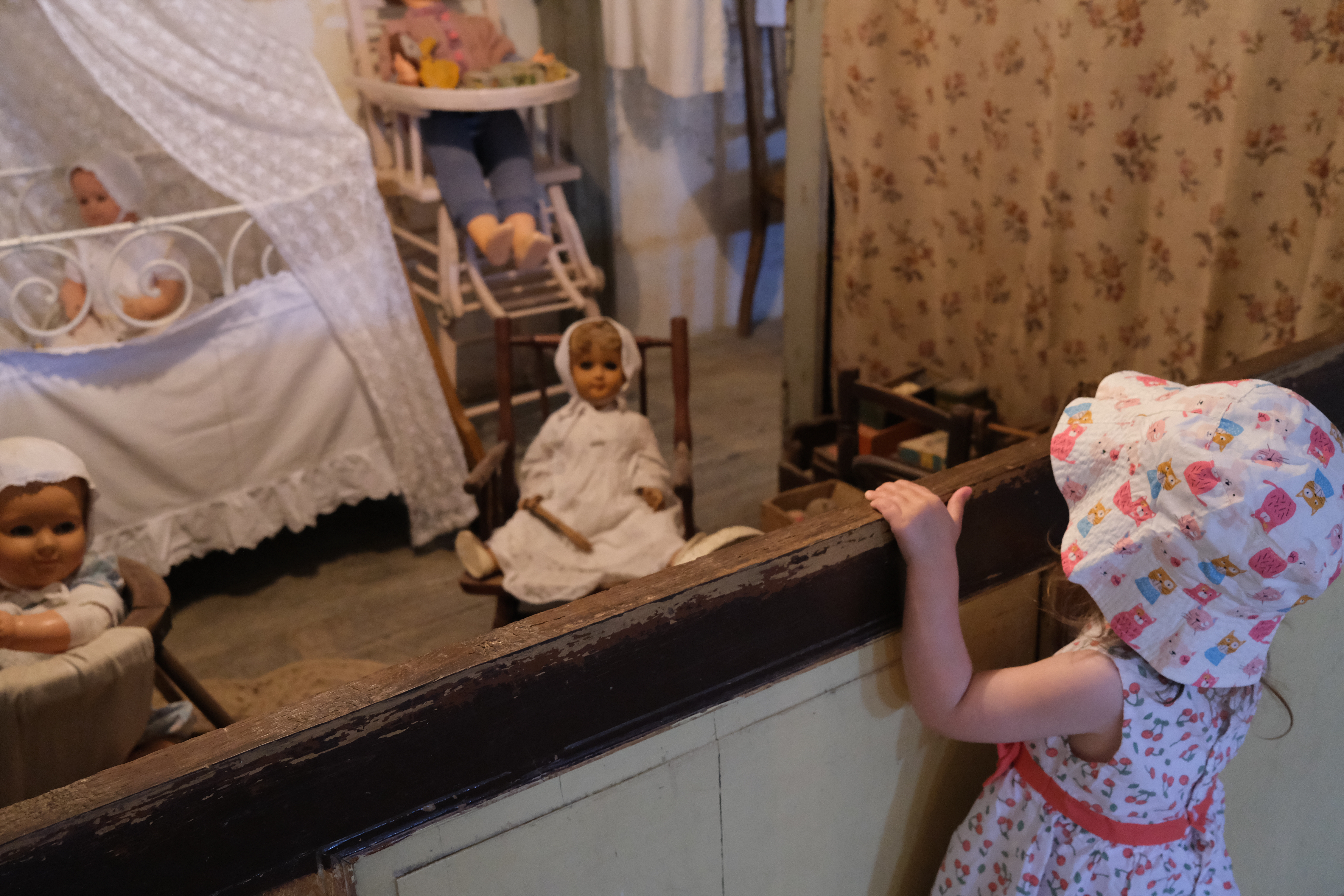
Ilinca looking at some rather creepy old dolls 
The school was closed, as we are on holidays after all, but it looked cosy and some of the benches looked familiar 
The embroiderer. 
I'm not sure it is an official craft, as I'm not sure people in older ages would go to some specific person to embroider stuff, but there is this embroiderer with the feminine embroideress; someone who ornaments with needlework. 
I know in Belgium there were and still are lacemakers, which this lady also did.
The horse was doing some agricultural job, maybe mincing the seeds, I don't know, but as I am essentially a vampire afraid of sun, I did not dare to venture closer to find out. It looked like the horse was on a treadmill (look into what a treadmill is and maybe, just maybe this is its ancestor). 
In one of the houses there was a family gathering. I felt a bit awkward looking at them, but they gave me butter and cheese and next door there was a bread oven... well you can guess what I did.
The girls and I in front of a lovely house which I believe was the house of the Weaver. It had around it all the steps from sheep wool, to thread, to a loom and finally a lot of washing machines.  
The washing part of the house
The washings hanging on to dry

Although I looked at the textiles, where I found them, what were the chances that the first embroidered piece I found had some carnations on it? If you are new here, my name in Turkish is carnation and after knowing that, I consider it to be my happy flower.
Watching the washing happen. Say that really quick!
The blacksmith
Part of the museum
Speaking of embroidery, I payed attention to the textiles, as you already know me. In Romanian we call these wall pieces, "peretare". They exist even today. I've liked this one in particular with two girls helping their mother cook.
I've spotted the embroidered piece from the previous picture on a place that sold goffres, but it was back in the shop, where I had no access. So I've asked someone to take a picture for me and they kindly let me inside pointing out to me the margins of a shelf. I know a friend of mine who dreams of having shelves like this and I took a picture for her. Also, examining it closer, I feel this embroidery was machine made, but well ... when you look for brodeuse in French you are welcomed by a ton of pictures of machines, so I feel it's fair. 
A flax stays and a linen one
Closeup of the flax one as we all know how linen looks
Washings in the lavoir (the place where women would wash clothes).
I like that some of the villages in this area kept their old lavoirs and you can see them today. I wrote about one in Luxembourg, here
The Carnations
Another flax garment
Another embroidered piece. Told you I was looking for them. This one looked hand-made.
If we are in this region we cannot pass by without talking about lace and embroidery.
This looked to me like a sampler, a piece of embroidered cloth on which a young lady would showcase her embroidery skills. I've wrote about a collection of samplers from Scotland, here.
Loved this window
Bonus: once you cross the border into France, the landscape fills with sunflower fields (say that real quick!)

I am aware half of the museum is not in these pictures, but either we decided we were going to leave some things for our next visit, or it was too hot to even think about taking to phone out.

That's it folks! As always I am more active on my Instagram @mademoiselle.ralu please give me a sign if you make your way through the heat to visit this place.

July 5, 2022

Romania - "Cos pentru o cauza" Exhibition in Bucharest

It has become sort of a tradition to be in Romania close to the IA Day, 24th of June. This year was no exception, but I went to Romania especially for this exhibition, Cos pentru o cauza. I've been there when this project took form and I really liked the concept, but somehow I did not understand how would it be put to practice. Well, let me tell you, that the ladies in the Semne Cusute Community are one of the most imaginative groups I have ever known. 

First of all the title, Cos pentru o cauza - I will choose to translate it as I embroider for a cause, although "cos" is translated as "sew", we are not tailors, we are artists, and creators, "seam" or "stitch" again did not seem right, we are not mending things that already exist. I may be wrong, as English, as much as I love it, is not my tongue, but as I see it, only "embroider" seem fit. To me "embroidery" is closer to art, although tailoring in itself is an art and although we do create entire objects, blouses...well, I may be wrong, please correct me if I am, but for now let's just call it, Embroider for a cause. 

There are a lot, but a lot of exhibitions of Romanian Blouses, all over Europe it seems, all related to June 24th the Day of the Romanian Blouse or to December 1st, the National Day of Romania, but to me, someone who has been closer to this niche, they are too many and not all of them have any purpose other than showing what the museums own or what the ladies of 2022 made. Yes it is important, as there are still Romanians who have no idea what a traditional blouse looks like, but I want more, I want exhibitions with a purpose. I want exhibitions that speak to many more people than the ladies and their husbands and friends who embroider blouses today. We already proved we know how to embroider, it is time to adhere to a greater cause. And what greater cause than the future of our kids, of our future generations?

The cause, "cauza" from the title is biodiversity and the bees and bugs the smallest of creatures that keep our all ecosystem going. The blouses have two sides, the colourful one, the world of yesterday and still the world of today, and a darker one the world of a maybe tomorrow. The exhibitions raises awareness of what might happen if you don't do diligence today. Traditionally, women of Romania would embroider on their blouses, their world, with the sun and the moon and the stars and all that there is on the sky on the shoulder part - altiță, the earth and its creatures on - încreț and the waters with their creatures on the rivers, the stripes you see on the sleeves. In a way old blouses show us the old world. We embroider them because we still have them, but what would happen in 100 years, in 200 years, if we keep going the way we are going? Well you have to visit the exhibition to find out.

I went to Romania with my daughter, because we have to pass it to future generations. Women of old times would pass the knowledge of the blouses to their daughters. I am involved in this magnificent and creative world, why wouldn't I share it with her?
The poster of the exhibition

As I've said the blouses raise awareness, but not only that. Ioana Corduneanu and the ladies of Semne Cusute Community don't just signal the problem, they also offer a solution. A solution against fast fashion, against consumerism, against harming people from less developed communities who work day and night to make the garments you and I maybe wear, once. The fast fashion brands make collections from one week to the next, it seems and we always have to have it all, but in doing that they cut costs. They pay less the workers, sometimes not allowing them the basic human rights, they use questionable fabrics, produced on a fast track using chemicals and pesticides to raise production. Sewing their garments very fast they make mistakes and one garment would last you a season if you are lucky, instead of years as it used to be. 

The solution proposed by the Semne Cusute Community is using fabrics from known sources, natural fabrics such as linen, hemp, silk and wool and less cotton. Because the request for cotton has grown so much in the last years, the producers are made to use pesticides to grow faster plants and raise production. This is dangerous for the workers involved in the process of producing cotton, but also for the environment. That is why in the last years the garment industry has introduced organic cotton, which is produces using less chemicals, but, to me, it is still a small step in the right direction. No one is saying, make your own garments, but just be aware. Choose quality over quantity! Choose linen and hemp! I have garments from those fabrics and they are good for cold and for hot temperatures, winter and summer. And why not, if you are passionate about tailoring, why not make your own? Or better yet, search for ReBlug on Facebook and see what others are saying about hemp jeans.
Back to the exhibition, don't expect a lot of photos from me, because the purpose of this post is for you to go see it at the Peasant Museum in Bucharest until July 10th, or keep an eye out for it as I bet it would travel. 
Even though I have my fair share of Romanian Blouses Exhibitions visited, even I was amazed by this one. The creativity of the ladies in the exhibition, the sheer number of bugs that are present on the authentic Romanian Blouses and old pieces of embroidery exhibited together with the new exhibition. You have to see for yourself!
I've particularly liked this one. Look at the biodiversity! You can almost say you are in a field of flowers with the bees buzzing around.
And again this one, with one side filled with bees and beehives and the other lifeless. 
\
This încreț is absolutely amazing! I have to use it somewhere. The creator of this blouse made the altițe herself on the loom and the blouse is made of hemp.

I am aware that you only have a few days to visit the exhibition, but this post is to remind you to look for it in the future. In the meantime, if you know Romanian listen to Ioana explaining each and every blouse, or just watch her without understanding the language, as I am sure you will understand the message. 

Normally I would advise you to go check my Instagram @mademoiselle.ralu as indeed I am more active there, but lately I feel less inspired to post something. It is very hot in Luxembourg as well and all I'm doing is ditch the heat. I will be back!

June 30, 2022

Romania - The costume of Queen Elisabeth of Romania

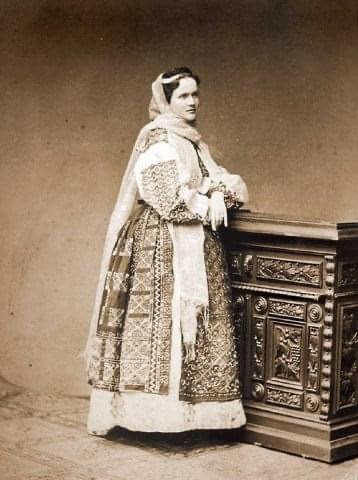
Let me tell you a story: a long, long time ago (1866) Romania became a monarchy with a king and queen, brought to my country from Germany after the local elite considered itself incapable of ruling and after many and long years of Ottoman ruling. He was Prince Karl of Hohenzollern-Sigmaringen and she was Pauline Elisabeth Ottilie Luise of Wied, or Elisabeth of Wied. They became King Carol the I'st and Queen Elisabeth of Romania. When they got married, she received as a wedding gift from the local ladies a national costume of Romania and a diamond tiara. She was photographed wearing them in 1870 and is painted in the same costume by George Peter Alexander Healy in 1872-1873.

Imagine my joy and humbleness to be in the same room with this costume and many more garments which belonged to the Kings and Queens of Romania at the National Military Museum, in Bucharest, in an exhibition which you can also visit up to September 30th.

***

La Muzeul Militar Național ”Regele Ferdinand I” din București s-a deschis o expoziție pe care orice roman ar trebui să o vadă, dar mai ales doamnele pasionate de cămăși și de costume populare. Se cheamă ”Costumul popular, simbol al identității naționale” și poate fi vizitată până pe 30 septembrie. 

De ce m-am entuziasmat eu așa de tare? Păi știți voi tabloul cu Principesa Elisabeta, ce avea să devina Regina Elisabeta a României, in costum național. Sau știți pozele aceleiași principese în costum național, cu fota pusă peste o crinolină ca să respecte moda vremii? Dacă nu le știți, le atașez eu acestei postări. Ei fix costumul ăla, există și poate fi văzut de aproape in 2022 în expoziția de care vă zic.


Principesa Elisabeta, 1870


Despre poza asta zic, e imposibil să nu o fi ochit pe undeva și să nu vă fi atras modul în care e poziționată fota, nefiresc pentru un costum național, dar total firesc pentru acea vreme, pentru o domnișoară ce avea să devina regină.


Ei, acesta este tabloul pictat de George Peter Alexander Healy in 1872-1873 în care la fel costumul este așezat pe o crinolina pentru a respecta moda vremii.

Principesa Elisabeta ajunge în București în noiembrie 1869 după ce se căsătorește cu Principele Carol I. În acest timp primește de la doamnele din înalta societate un costum popular românesc și o diademă (tiară) cu diamante. Cu acestea este fotografiată în 1870 și apoi pictată între 1872 și 1873. Deși când vorbim de familia regală și de promovarea costumului național, mai repede ne amintim de fotografiile cu Regina Maria, puțini își amintesc că de fapt prin simplul gest de a îmbracă costumul și a se fotografia în el, Regina Elisabeta și nu Maria a fost prima care a promovat purtarea costumului în înalta societate și printre doamnele de la curte. Că mai apoi, în timpul Mariei apar școlile de fete care învățau să brodeze costumele e foarte adevărat. În fine.


Este fără dubiu același costum din tablou, același, vă puteți imagina?
Cămașa este cusută cu mătase și fir metalic pe fâșii de pânză aplicate pe borangic cu dungi


În această poză se vede și mai bine cum e lucrată mâneca. Este o minune și mă bucur că trăiesc timpul în care aceste minuni sunt făcute publice. Sper sincer că una dintre fetele frumoase și talentate ce cos cămăși în zilele noastre, se va încumeta să o recreeze. 


Și minunile nu se opresc aici, în aceeași expoziție se află de la stânga la dreapta, cămașă care a aparținut Principelui Carol viitorul Rege Carol al II-lea, jos, cămașa Principelui Nicolae, fiul Reginei Maria și Regelui Ferdinand, fratele lui Carol al II-lea, bundiță ce a aparținut la fel Principelui Carol, precum și fota Mariei, unicul copil al Elisabetei și al lui Carol I, Itti, ce a murit de scarlatina la 4 ani.


Se vede puțin în stânga fotografiei costumul de copil cu motive ”schilărești” ce a aparținut Principesei Mărioara, viitoarea Regina a Iugoslaviei, fiica Reginei Maria.
Apoi rochia și mantia Reginei Maria a României, la fel cu motive ”schilărești” de Gorj. Regina apare purtând astfel de haine în poze deja cunoscute.
În plan îndepărtat, Costumul Principelui Carol, cu aceleași motive.


Poala din costumul Reginei Maria


O altă piesă importantă mi se pare cămașa Ecaterinei Teodoroiu

De ce e importanta? Pentru că în imaginile rămase cu Ecaterina Teodoroiu o vedem mereu în uniformă militară (nu știți despre cine vorbesc? căutați bancnota de 20 RON), însă știm că era din Târgu Jiu și că până la Primul Război Mondial, de fapt până la moartea fratelui, probabil a purtat haine civile. Așa că cel mai probabil avea și ea o cămașă de ieșit la hora și mi se pare incredibil că această cămașă poate fi văzută în 2022 la Muzeul Militar. Nu am găsit poze cu ea de dinainte de ”înrolarea” în armată, dar am găsit cel mai cuprinzător articole despre ea în Formula As. Acolo scrie clar că se păstrează lădița de voluntar a Ecaterinei și că parte din obiecte se găsesc la Muzeul Militar Național din București. Sper sincer cineva să îndrăznească să o coasă și pe aceasta.

Expoziția mai are câteva piese de îmbrăcăminte și obiecte regale, dar dacă vă pun poze cu toate ce sens are să mai vizitați voi? Ori eu fix asta îmi doresc, să ajungeți acolo și să vedeți aceste obiecte cu ochii voștri. Cel puțin costumul Reginei Elisabeta are peste 150 de ani. În țările astea pe unde mă învârt eu, se face mare tam tam pentru o rochie cu cristale veche de 60 de ani, ori aveți la o vitrină distanță haine purtate de Regii României, haine istorice. Le puteți examina de aproape, puteți scoate modele, puteți vedea tehnicile prin care au fost făcute și mi-ar plăcea daca peste un an ar apărea și replicile acestor cămăși aduse în anii noștri, cu materialele pe care le avem acum la dispoziție și cu toate cunoștințele pe care le-am acumulat.

Este mare lucru că aceste obiecte s-au păstrat și sunt expuse. E o expoziție eveniment pe care mă simt onorată să v-o pot aduce în atenție. 

Ca de obicei mă găsiți mai repede pe Instagram @mademoiselle.ralu