Translate

February 14, 2022

Searching for St. Valentine in Dublin

This post was originally written in Romanian back in 2012

If you think about it, you wouldn't call Dublin a romantic city, but it is. Somehow the old Gothic buildings, rainy weather and dark sky don't spark romance, but the multitude of castles, of old Victorian houses, the green of St. Stephen, the joy of seeing a blue sky and occasionally a rainbow they are romantic in some way.

And Ireland as a whole is full of true love stories. Here are a few: 

Kylemore Abbey is located in the Druchruach Mountains of Galway - Connemara. The story goes that a man named Mitchell Henry began building the castle and the surrounding area after spending his honeymoon with his wife Margaret in Connemara. For his wife, he built a fairytale castle and wanted it to be a living proof of his love for her. Unfortunately, Margaret died in 1874 and never saw the end of her castle. Today the castle can be visited. 

Another Irish love story happened between Cu Chulainn and Emer. When he saw the beautiful Emer with Chulainn, he wanted to marry her. However, her father hated Cu Chulainn and sent him to train in the art of war with the woman-warrior Scathach, convinced that the heavy regime would overthrow Cu Chulainn. But the love between the two made the hero resist the hard training and, much stronger, he returned to his girlfriend, conquered the fortress where her father hid her, kidnapped Emer and soon they got married. Love overcomes everything. 

The most beautiful Irish love poem was written by the poet Patrick Kavanagh, it is called Raglan Road and was written after the poet fell in love with a stranger walking on Grafton Street.
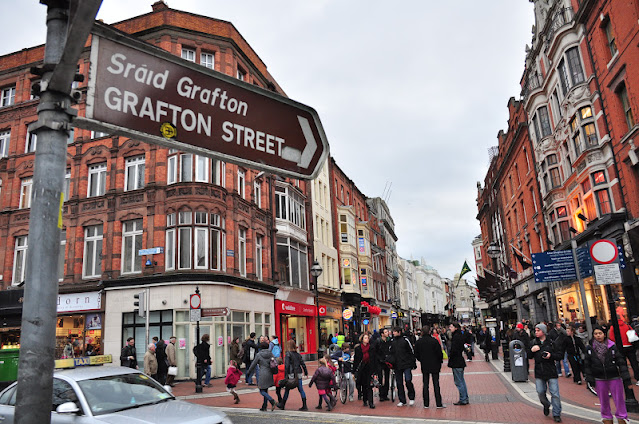

Perhaps the strongest argument in favour of the theory that Dublin is a romantic city is that St. Valentine himself is resting in Dublin. And I only found out on the morning of February 14th, the day of Valentine's Day. 

I guess you all know by now that Valentine was a saint and not an invention of a big beverage company like Santa, he lived in Roman times, during the reign of Emperor Claudius II, when men were encouraged not to fall in love in order to fight better. In those days, St. Valentine married several couples in love and preached for love. He was imprisoned and during his detention he healed the judge's blind daughter. Before she was killed, he sent her a love letter, which was not signed. Hence the custom of Valentine's love letters called valentines. 

So on St. Valentine's day, in 2012, I lived in Dublin and read about the saint being buried in a church in the Irish capital and decided to go and see for myself. On the way it was like I was for the first time in Dublin, I did not remember the bus routes to the centre and even though the church is somewhat central I had no idea how to reach it. In my panic, I've asked a stranger on the street about St. Valentine and the young lady searched online the information and found out herself that the Saint was indeed buried in Dublin and then searched for the correct bus number to reach the Whitefriar Church. I've asked the bus driver to let me know when was the time to descend and here I was. 
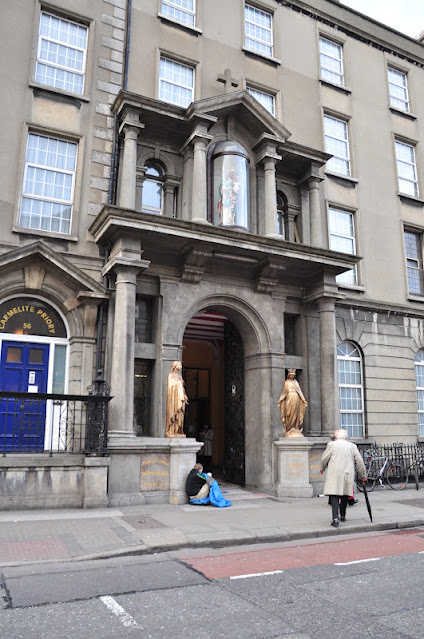

In a Carmelite church, I've entered and felt unease as I don't know how to act in a polite way. The service was about to begin and I was urged to a seat. I sat down and listened to the priest, the people around me sang and recited after the him, and at the end the he told the story of Valentine's Day and urged us to stop by the Saint's coffin.
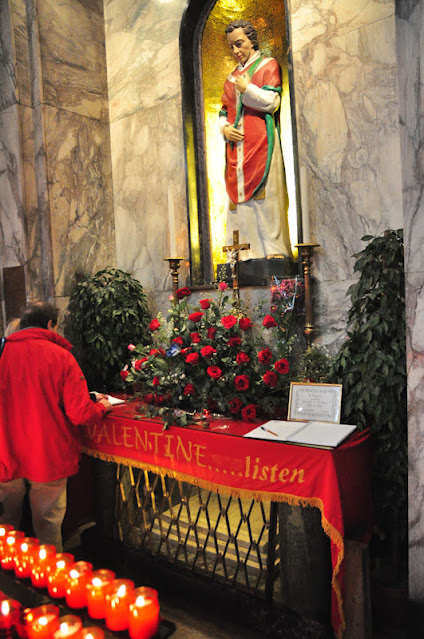

I stood in line, among those carrying flowers, and lit a candle. I took the picture above and tried to leave, but it was not that easy as someone told me I have to write something to the Saint. I stood there with nothing on my mind, but managed to write a few lines. On my way out I was stopped by a radio journalist who was doing a St. Valentine vox-pop. I've answered the best I could and went to the street, where I saw love everywhere. 
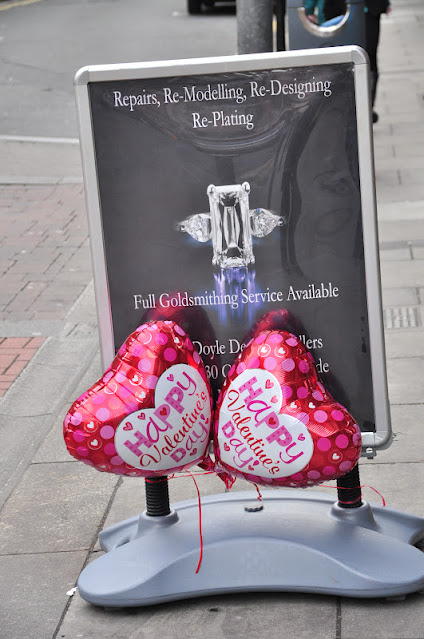

A goldsmith service


A restaurant
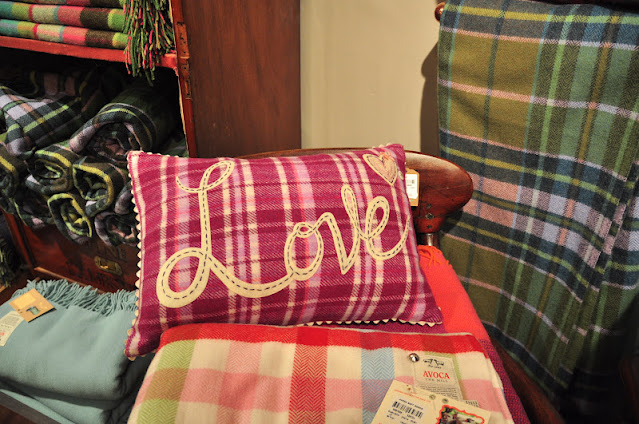

And in my favourite store in Dublin, Avoca.

I'm not a romantic person, I don't like receiving flowers or small hearts, I don't like romantic candlelight dinners, but I like simple things, a handwritten card, the croissants my husband remembers to buy every morning, the little gestures as washing my daughter's bottle so I find it clean when I wake up at night. Maybe is the age, maybe I've always been like this, but when today he picked up a heart-shaped cake just because he felt like it and we all (Luna and Ilinca included) dug in and ate together, it may not be romanticism but for sure is love.

On February 14, 2012, I discovered Saint Valentine in Dublin, but celebrated his legacy every day since.

Raluca

November 15, 2021

Luxembourg - Meet The Tall Banker

I was talking to my friend after a meeting in Kirchberg when I've spotted him just like that, the Tall Banker. Of course I've stopped and took pictures, but who is this banker and why does he have a statue in Kirchberg?

If you are not familiar to Luxembourg, Kirchberg is the European district, a place with more office spaces than housing, at least on the main street. When I've worked in Kirchberg, I had colleagues telling me that in the 80's that was an agricultural field with just one big tower and they used to say "let's meet at The tower" now there are at least ten towers in Kirchberg and during the week it's very crowded with office people, bankers or not.

So that is maybe why they chose to place the Tall Banker here. 


The Tall Banker is about eight metres in height, but its creators, the German artists Inges Idee, have given him a normal person's waist. He is supposed to define a "successful corporate culture, where progress, profit, optimisation and vision are key". 

To me, he looks exactly like "An Alien in New York" in Sting's song, someone so refined that it almost doesn't fit in a new environment and is considered an outsider, an alien, a stranger. You have to know a bit of the story behind the alien, but safe to say, to me he looks like an stereotypical, romantic and old version of what a banker, a corporate person should look like. In a suit, with an umbrella and a financial newspaper under his arm.


His shoes size is 96 compared to mine's, 38.


To me Kirchberg is a district left to be discovered to its full potential. There was an art tour at some point, but I could not find anything about it online. There are a lot of sculptures in Kirchberg, a few very close to the Tall Banker, I wrote in 2018 about the Knotted Gun which is in a park, also in Kirchberg. The area is crowded during the week, but come the weekend it is quiet and is worth a visit. 

I hope you found something useful reading this article here, today. If you want a chat I am on Instagram @mademoiselle_ralu


Source:

November 1, 2021

Luxembourg - Art is everywhere

The eyes. I was sitting on the "terrace" of Oberweis inside Robert Schuman Hospital in Kirchberg trying to eat a croissant. I was 30 minutes early to a meeting with my endocrinologist and I thought I'd spent it there scrolling my Instagram. With the corner of my eye I spotted something blue. It was a painting and it's presence in a hospital intrigued me. So I've finished my meal and went to investigate. Turns out the painting was one of two, they are both in the main entrance hall of the hospital, they are called "Merci", they were painted by a nurse which works there and they were paying a tribute to the hospital staff engaged in the fight against Covid-19. 

From there I went down the rabbit hole of the internet and found the website of the artist who is Belgian, born in 1977, studied painting in Arlon and lives in Habbay - Arlon. Her name is Gilliane WarzĂ©e so please do try to remember it as I think you will definitely hear about her soon. 


I don't normally get excited about contemporary art unless it tells me something, it makes me turn, spend the time to observe it. The pandemic times have been an inspiration for many artists, but to me the two paintings have a deeper meaning, being made by an artist, but also by someone who's been fighting this thing in the first lines. Where does she find the time to even be creative?

The two paintings are in the same style as others on her website, but to me the one looking at us front and personal, asking us why? has created an emotion. Maybe I've discovered it (them) in a time when the pandemic is almost over in Luxembourg, but is hitting harder than ever my home country, maybe I was a bit vulnerable going to see a doctor, even though she is very nice and I don't have a major endocrinological condition to worry about, I don't know what my subconscious was reacting to, maybe it is as simple as them being blue, but they moved me and isn't art supposed to do that?

So without getting even deeper into the melancholic state, if you ever are at Robert Schuman Hospital, first I hope you are well and just for a routine check-up, and second, please spent a few seconds in front on any of the two paintings. It will do you good. 

To put a face to the paintings I've borrowed a picture of the artist from the mighty Internet, I will credit her for it, but in the meantime if I will find another source you will see it here. 

Art is everywhere and can be made anytime!

With my two cents about the topic, I will remind you that I am more active on Instagram @mademoiselle.ralu and sign out! 


Sources:

October 25, 2021

Luxembourg - Meet Nana

Apparently Nana's history is way longer than our history in Luxembourg, but I came to meet her back in 2019 when she stood proud in the city centre. 

Recently I was in a bit of a shock not to see her in her usual place and found out from Instagram that they moved the statue to the garden of the Vauban Villa, but that will not be her final place. So let's start from the beginning. Nana, by her real name "La Grand TempĂ©rance" is the creation of Niki de Saint Phalle, an artist who had a thing for big, curvaceous, colourful ladies statues. During her lifetime, she died in 2002, she created more than 3000 sculptures, big or small, but always colourful. 

According to the press, Nana came to Luxembourg in 1995 to celebrate Luxembourg as a European Cultural Capital. She was placed on Boulevard Royale near Hamilius. There were different times back then (although to me it seems like yesterday) and people did not appreciate her curvaceous body. Lux Times even said that an Octave Procession had to change its course to avoid the statue or in one year they covered the statue altogether. She was taken down in 2011 in anticipation of the works at the Hamilius area so that is why when we arrived in Luxembourg, at the end of 2012, I had no idea she even existed. 

Nonetheless, in 2019 she came back to Luxembourg and was placed near the Post Office, still in the Hamilius area. 


I found her there last year around Christmas when I took this picture

So when, this year, they moved the weekly market from Knuedler to Hamilius, Instagram was flooded with pictures of Nana surrounded by flowers. During the Summer she looked lovely. As of the pandemic, I had no business being in the city centre on a Wednesday, so I could not take a picture of my own, but when I did come to Luxembourg, she was moved again.

She is now in the garden of Villa Vauban and Ville de Luxembourg says it will stay there until 2023 when the works of the old Post Office will be over. It was there where I found her on a rainy day, she is visible from the street, although she has the back to the street and the face towards the villa. 


So that's it, boys and girls, she is Nana, a 6 metres tall colourful sculpture, made by the artist Niki de Saint Phalle, bought by the Luxembourg City in 1995. As usual you can find me on Instagram @mademoiselle.ralu

October 18, 2021

Luxembourg - Discover a place celebrating women's history

Today I want to take you to Pafendall or Paffenthal a neighbourhood in the old Luxembourg. First mentioned in the 15th century, it was a popular neighbourhood for all sort of craftsman who were making things along the banks of the river Alzette. At one point it had its own language, a dialect of Luxembourgish, called Yenish. In our days it is known for the Panoramic Elevator which connects it to the centre of the city and for the Funicular which connects it to the Kirchberg area. 

In the middle of Pafendall there is a basin which is called kneipp path (foot bath) where one could exercise the stork walk which improves the circulation. But before that was transformed into a contemporary socialising place, the kneipp path was a lavoir, a place where women would come to wash clothes. 

This particular lavoir was one of the four washing spots that existed in the area and the only one surviving today. It was built in 1931 and it was used for more than forty years up to the era in which running water was introduced in every house and the washing machines became popular. It was a place where women would come to wash, to meet and to chat. It was restored in 2016 almost at the same time they installed the Panoramic Elevator and if you want to find it, it is across the street from the church.

Close to the Luxembourgish National Day, which is June 23rd, there is the Day of the Neighbourhood in which they organise a water carrying contest for children around the old lavoir. 

The place has a specific energy and if you visit it on a sunny day as I did, take a coffee or a sandwich with you to enjoy it, who knows you might meet your next best friend there.


A shorter post for today, as I am in a very busy part of my year, but rest assured I have more stories to tell you about Luxembourg, friendship and collies :) so stay close. I hope you've liked reading this post as much as I've enjoyed writing it, hope to spot you on Instagram where I am a bit more active @mademoiselle.ralu 

P.S. Pit Weyer a graphic designer drew the pattern for the railings that lead to the lavoir trying to recreate the old, local, colour of the neighbourhood, with women washing clothes and children playing.