Yes, you've read it well, while in Romania, I've visited five exhibitions about the Romanian Blouse. It's not that the topic is very popular, it was just the fact that on June 24th there is the Day of the Romanian Blouse, celebrated all over the world, and in Romania they have these little events, which more often than not turn out to be exhibitions of Romanian Blouses called IA.
Since 2013 when this day was first celebrated, this year was the first one when June 24th caught me in my homeland. Usually we have a small celebration in Luxembourg, but because they are so undecided about the rules and one day they allow gatherings and the next day they ban them, we decided that maybe this year we skip the public celebration all together. And as there is no interest in an online event, I hope everyone celebrated the blouse and the day in their own way. I know I did, and I hope to find the time to tell you all about it in another post.
So, five exhibitions. First I want to say that I wish The Day of the Romanian Blouse would be celebrated everyday. It is a good thing that these wonders are out of storage and exhibited to the public around June 24th, but wouldn't it be even nicer if they would be exhibited all year long?
I've visited three exhibitions in Bucharest, one in Iași and another one in Piatra Neamț. They all exhibit Romanian Blouses, IA, but they all have different somewhat topics. In Bucharest I went to the Peasant's Museum at the [În]toarcem Cânepa spre viitor Exhibition. The topic was hemp, cânepă in Romanian. They explained all the stages of producing hemp fabric, they showed contemporary objects and old ones made of hemp and they had two Romanian blouses made partially of hemp. It was interesting because I do believe the Romanian public is a bit unaware about hemp and only associate it with drogues, but I think they did not achieve their purpose as the exhibition was a bit too contemporary for my taste.
A blouse where the back was made of a more rough hemp fabric
An old Pădureni blouse, part of the Hunedoara region of today
This is an example of a contemporary art in Romania today. Basically let's shit on the past and mark it with something. Why am I saying that? Because those look like old children shirts, some the museums have not deemed as important or worth keeping, so they will be sparse at one point, and forgotten. And "the artist" machine embroidered something on them.
I don't understand why these creations are promoted, but Romania still has its roots deeply into its comunist past and some people are promoted not because they are worth something, but because they are part of something... Sad
The two blouses were fine examples of hemp usage and as a person who has hemp blouses, Romanian blouses no less, I can tell you that hemp is a fabric coming from the past, but a fabric for the future. We should steer clear of plastic fabrics and turn our eye to the natural ones. Read a little, google it a little and try natural fabric cloths and you will see what I mean.
***
The second exhibition I've visited was the one in Iași, it was Chipuri și cămeși at the Palace of Culture. It was interesting as the blouses from Maramureș region in Romania are a bit different from the blouses from other regions. For starters they have a different form, derived from the form of IA, but different. That is to be explained as Maramureș was for a long time part of the Austro-Hungarian Empire and was influenced by the fashion of Vienna and Budapest. They are still Romanian blouses though.
Those are called ciupage, after the part they have on the neck. The embroidery is made on the pleated fabric.
I am someone who hates to make the details on a blouse, those tiny little things which you could consider unimportant, but which make a blouse. See how the sleeve has a crochet part at the end? and then the embroidery again on the pleats?
The exhibition was interesting for me, the concept was good: showing the blouses, but also the people who might wear them. It is important to make the distinction between the Romanian Blouses from Moldova and Muntenia, the Carpathian type of blouses, with altițe and gathered around the neck and the Maramureș ones, but most importantly we should not forget the old blouses and start to innovate in such a way they become unrecognisable for the future generations. What is now produced in Maramureș and worn at the church or during certain celebrations, has nothing to do with the old archaic blouse, and that is a shame.
***
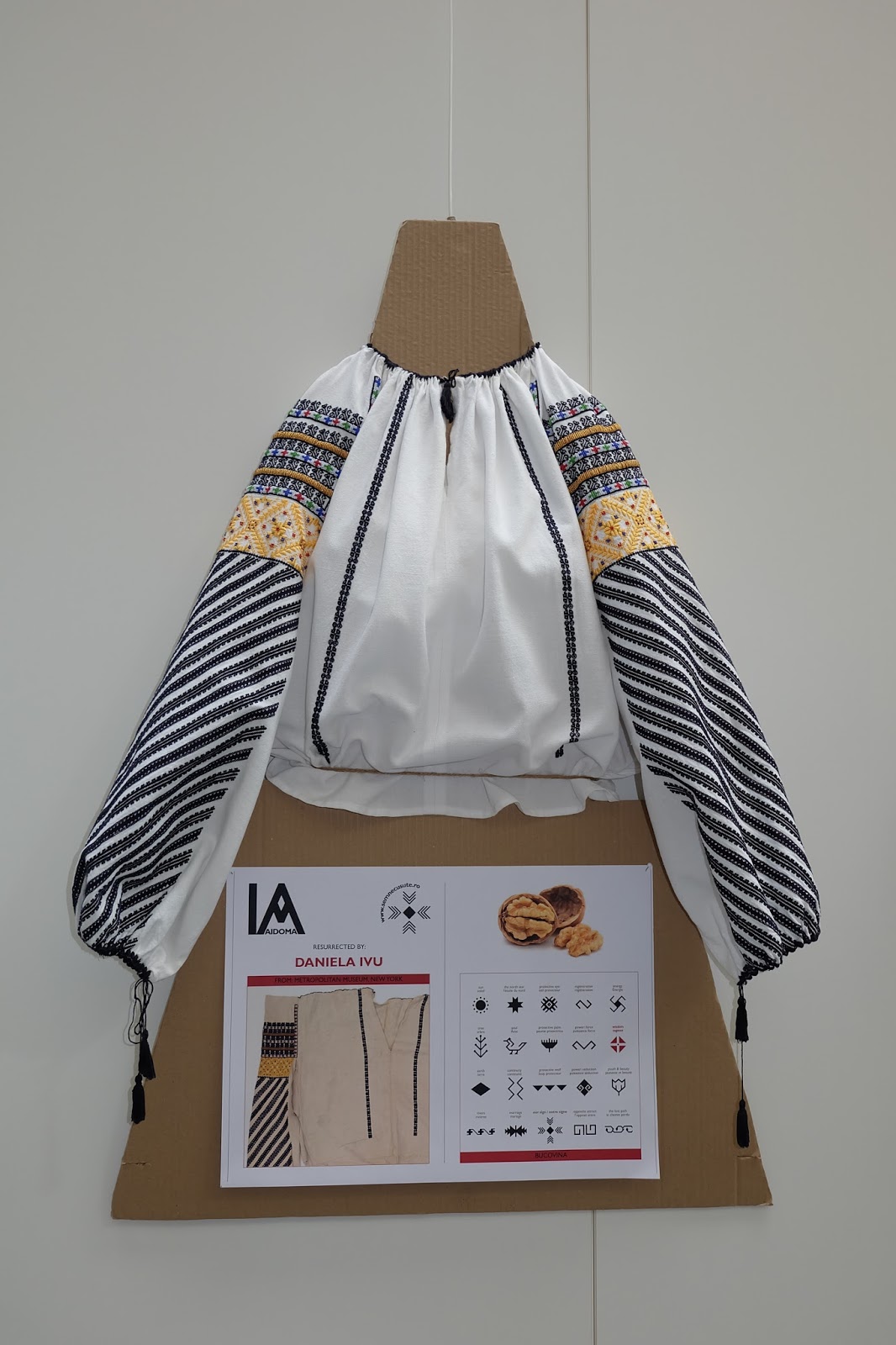
The third exhibition I've visited was the one in Piatra Neamț and I really made an effort to be there and I was impressed. In Romania there are women who now can make correctly a Romanian Blouse. They gather in șezători all over Romania and the Piatra Neamț is a very good example of a gathering of women working with the local ethnographic museum. In De la I(zvoad)E la IE exhibition they recreated old blouses from the museum storage, in some cases, they created entire blouses because what was left in storage were old pieces of embroidered fabric called izvoade. That takes a lot of reading and documentation to know what exactly goes where. It was a long and ambitious work and I am glad I got to witness that.
This is the blouse embroidered by the curator of the exhibition, from the Ethnographic Museum in Piatra Neamt
This blouse was made by my friend and not because was made by my friend, I'm considering it the most important in the whole exhibition. It is important because it has an element I would place in other parts of Romania, but see it was present in Neamt as well. It proves the unity of Romanian provinces.
This is one of the blouses I've liked. They were a few, but you have to go and see the exhibition
I've liked the exhibition as I knew I would. Indeed the blouses are top of the top, the craftsmanship is impeccable. As someone with a fair share of exhibition on the topic on their back, I say that some of the blouses were a bit childish, a bit missing something. It was not the craftsmanship, but the materials used, I think. When you work on something like that, you want best of the best fabric and threads. As did the peasant women who first made the blouses in the museum the ones who endured the test of time. Well, some of the fabrics were a bit lacking structure, a bit I don't know how to describe it. Don't get me wrong, do go and visit the exhibition, take detailed pictures and examine them at home, learn as you have a lot of things to learn from such an exhibition. I am someone who saw a lot of Romanian Blouses as I am someone who saw a lot of exceptional Romanian Blouses made in the last years. I have a bit of different standards when it comes to the subject. Nonetheless, an excellent exhibition and again an example that when the curator takes on the needle and starts embroidering, masterpieces of exhibitions follow.
***
The forth exhibition was the one form the Village Museum, again in Bucharest. Arta cămașii cu altiță is called. If this is the first article you stumble upon on my blog, you have to know that altiță is the part that is on the shoulder of a Romanian Blouse, it bears heavy embroidery as it is the most decorated and important part of a Romanian Blouse. The folder that Romania submitter to be recognised by UNESCO as world heritage emphasises exactly this element, the shoulder part, the altiță. So, in theory, this exhibition was supposed to have only these type of Romanian Blouses as it is called The Art of the Blouse with Altiță.
This is the altiță, the part embroidered with something similar to water birds
I'm not sure, but I think I saw this blouse made in our time in an exhibition in Sibiu
So on a Romanian blouse there are rules and they aren't. Sone of the unspoken rules says that the altiță element should not ”fight” with the încreț element, the second element right after altiță. If one were to look at the blouse, should be attracted either by the altiță or by the încreț. Well, here they are both heavily decorated with embroidery and sequins and to be honest, to me it looks fine, it looks together, as it should be.
Here, you see, the altiță although decorated is a bit fade compared to the încreț which attracts the viewer's eye
I don't want to speculate here as I don't know what is going on at the Village Museum in Bucharest, and again I speak as someone who has seen a lot of exhibitions and organised some about the IA. To me the exhibition seemed put together in a hurry, not even removing the elements of the previous exhibition that was present on the same space. The exhibition did not have a clear explanation as to why on the walls there were the pictures of the Romanian Royal Family and also why the Manager of the Museum had something similar to an award gallery wall as part of the exhibition. I've asked. The keeper of the exhibition is very well informed and willing to talk and explain, but I feel that the mistake is laying somewhere above his head. Nonetheless, there are some good blouses to learn from in the exhibition, there are the blouses which belonged at some point to one of the Romanian Queens, you have a lot to see and learn from that exhibition.
***
The fifth and final exhibition was an unexpected one. First because it was organised in a space I knew to be derelict and now is reconstructed nicely and is a good exhibition and cultural centre in the heart of Bucharest. Its name is Arcub Hanul Gabroveni, han in Romanian is inn. So a former inn turned into a cultural centre. The exhibition is Chimonoul întâlnește IA and I have to say it is the exhibition which steps a bit further and appeals to the knowledgeable one, that being me. The exhibition has a clear theme and places IA, the Romanian Blouse, next to another traditional and sacred element of clothing, the Japanese kimono. As if to say, everyone knows what a kimono is and looks like, well here is IA. At least this is how I saw it.
I like blue. I should accept it by now and stop calling it the "blue period". This blouse was on the poster of the exhibition, and although there were better looking and executed blouses, my eye kept returning to it.
A Romanian blouse and a Japanese kimono
The blouse which belonged to the Princess Ileana of Romania
Please do read who she was, read her books, her biography, her part in the Romanian Royal Family
The blouses exhibited belonged to old and recognisable Romanian families, so here is another element that intrigued me. They are important and valuable because they at one point dressed high class Romanian women. They are a bit different to the ones exhibited at the Village Museum or the Peasant Museum in the sense they were commissioned to look in a certain way, to feel in a certain way and not because the woman making them put all the fine materials she could find and spend time and creativity into making the blouse. So, in this sense they are not as traditional, but make no mistake, they are valuable. They represent the next step, logical step into the evolution of Romanian Blouses. I saw that happening in the contemporary groups of women who are making blouses now. They make one blouse, then another one, they are part of a project, more often an exhibition, they make an urban, hemp, blouse, but then they are hooked and they enjoy embroidering not for them but just as a hobby. So they start making blouses for their family members, daughters, mothers, mothers-in-law, friends, but then what? They start selling their craft. They sell their first blouses to create better ones, then they start embroidering on commission altogether. It must have been the same with the women of the past. That is how the blouses in this exhibition came to be. Commissioned, but valuable nonetheless.
So that my friends concludes my tour of some of the exhibitions organised in Romania on the Day of the Romanian Blouse. Almost every ethnographic museum in Romania marked the day in some way. I am glad I had the chance to visit the ones I did. I wrote this article for my friends here in Luxembourg or around the world who haven't had the same chance, but if you are starting now on the journey of learning about Romanian Blouses, please do go to your local ethnographic museum, study the blouses they have on display, ask about future exhibitions, open the books they sell, then go online into one of the facebook groups of women who are making the blouses now and make one for yourself or if this is not your thing, know how to ask the question.
As usual I am more active on Instagram @mademoiselle.ralu