Translate

December 29, 2022

Germany - Three days, three Christmas Markets

I was a bit hesitant when my husband proposed a quick getaway three days before Christmas, but I was also the one complaining about not going to the Christmas Markets in Luxembourg and not drinking enough mulled wine. I've imagined that the prices would be astronomical, similar to the ones in Colmar or Strasbourg, this time of year, but it was very affordable, so everything fit into place and on December 20th we arrived in Rothenburg ob der Tauber.

If you search Christmas in Germany or German Christmas Markets it is bound to appear in the first ten results if not the first one, so I was a bit surprised of how easy it was to get a room and to make the 5-ish hour drive. The bad part was that it rained a lot, but not a drizzle, rain that would get you wet within the first 5 minutes. So although our plan was to stay in Rothenburg and visit its museum and walk on its walls, we had to plan according to the rain. 

In Rothenburg there were Christmas trees everywhere and the town looked right out of a Victorian Christmas Card

I've tried to take artistic photos, but that is simply a pointless endeavour with a kid or a dog hanging from you, with mittens because it is Winter and with occasional rain. So this is what you get. 

I am a tourist, a traveller if you want. This picture best describes my joy of finding new places and absorbing it all, forgetting to take pictures sometimes, but having my phone in my hand.

Our first option was Nuremberg, a big city with a lot of museums and shops where one could ditch the rain. It was at about 45 minutes to an hour drive from Rothenburg, we checked the Railway Museum, it is nice and at the end the children area is to dream for, but by the end we were all tired and even Ilinca wanted to eat something and not play. So we went to the Christmas Market, as the sun made a brief appearance.

At the Railway museum in Nuremberg. I was hoping they had more than just one or two trains you could go inside, but it is a museum I would recommend. 

If you are wondering who is listening to all those recordings in German, well Ilinca was. That is what I would tell the people at the museum, to at least add some English explanations. 

At the children area they could go on a miniature train, they could ride those things shaped as a train, they had train sets to play with, they had a clues solving circuit where they would learn things about trains, I assume. It was all in German. Next time I would come only for the children area.

In Nuremberg we went to the castle, but managed to visit only its cafe. The panorama was nice with the sunset.

The third day was again raining a lot and I wanted to do some last minute Christmas shopping and where better if not at TK Maxx. Turns out that there is one in most of the towns close to Rothenburg, so we chose Wurzburg. The store was disappointing, but we still found what we needed and then we headed out to the Christmas Market.
I've seen those instagramable wings everywhere, so I couldn't resist a photo

The markets

In Rothenburg ob der Tauber, the Market closes precisely at 7 p.m., but there are some restaurants in the area good and affordable and also the whole city is decorated so nicely that walking is an experience in itself. The mulled wine was good and they had some nice sausages. The atmosphere is so nice and cosy, everyone seems to know everyone and the sellers and locals are very friendly.

The market in Rothenburg was, to me, very local with stalls selling cheese and ham and even yarns for knitting.

The market in Nuremberg is worth a whole day. It is huge and with a lot of stalls. It is wonderfully decorated, but it is crowded. Navigating it with a dog and a toddler in a buggy was difficult. But again the atmosphere was nice and the mulled wine was good. 

In Wurzurg was raining cats and dogs and Ilinca fell asleep so we had to take shelter and we did on the terrace of a lovely coffee/restaurant. The market had a lot of stalls selling almost the same stuff as the ones in Nuremberg, the mulled wine was only white, but because of the rain we did not have that many options, they could very well have red wine, we just did not find it.

The first day in Rothenburg

Seeing the iconic place for the first time. As it was the gate we would use to go into town, I've almost missed it the first time, but tourists with cameras gave it away.


It was difficult to take a good picture, so this all I've got.


Ilinca inside the German Christmas Museum in Rothenburg


At the end of the visit we were asked to make Christmas decorations. I haven't spotted any in Romanian so I've made one.

Was it worth it?

YES. YES. YES. Any trip out of your home is worth for the child, for you and even for the dog. You see new people, interact with new cultures and customs and learn a thing or two in the process. I would go back to the area in the summer, to see the coloured houses of Rothenburg decorated with flowers, to check other museums in Nuremberg and maybe go back to Wurzburg as well. 

Although very similar in style to the Strasbourg Colmar area, the prices are normal, the food is similar, but they have schnitzels which for me is always a plus.

The drive wasn't that bad, we stopped once or twice, but we are accustomed to long drives, so five hours wasn't even that long. There isn't any speed limit on some parts of the motorway in Germany, so my husband was happy to test his German car. I wasn't looking :)

Next time I would book a hotel in Rothenburg old town, we chose one next to the walls, it was nice, it was in a house made to look like the old ones, it was close to the centre, but next time, if I find one with parking and allowing dogs, I would like to wake up looking at the coloured houses.

As you know, Germany is very dog friendly. I had no problem finding a hotel that allowed dogs, she came with us in all the restaurants and all the shops. She wasn't allowed inside the museum in Nuremberg, but she was allowed inside the Christmas Museum in Rothenburg. 

That's about it from me. I hope you find this article informing, and I hope you will add Rothenburg ob der Tauber on your travelling list. You will find me on Instagram @raluca.caranfil 

December 12, 2022

France - Small Christmas market in Avioth

It's been so long since I've written anything here that I have almost forgotten the password, but here I am. Does it make sense to say I'm working on a new face for my blog and my social media outlets? Don't think so. You will see it when it will be ready. In the meantime, on our region winter came and with it the Christmas Markets. This year, the abundance of markets made me look for the smaller ones, hopefully less crowded ones, the more authentic ones and so it happened that most of the communes in the area (Belgium, Luxembourg, France) organised markets that last just one weekend or maybe two. It is the case of Avioth in France, very close to Orval in Belgium which is maybe more known to the readers of this blog.

Avioth is a village with few houses, according to the internet, with 144 inhabitants, but a big cathedral dedicated to Virgin Mary, Notre Dame. The village is better known as a place of pilgrimage, as in the 12th century a statue of the Virgin was miraculously discovered. In the 13th century a large Gothic church was build and in 1993 by the decision of Pope John Paul II it became a basilica. 

To me, the church looked imposing and big on the outside, but very warm and cozy inside. We discovered Avioth very early when we moved here (we moved here in November 2012 and according to the blog, visited this place in January 2013), together with Orval and Montmedy, but haven't been there in at lest six years if not more. BUT Avioth evolved and their Christmas Market made it to Facebook and from there on to my calendar so I would not forget to visit it, as it was open for just two days.

The Christmas Marked was a Christmas Market, it had mulled vine and gaufre and it had Santa and houses with small crafts and of course Orval beer which was drank in glass glasses not in paper ones as everything else, it had a big tree and it cost one euro 50 to enter. To me, though, the village looked even more charming than the small Christmas Market. All the houses close to the church were nicely decorated with wooden figurines, there were three or four artist workshops and some small brocantes. It was charming and I'm glad I've convinced myself and my family to brace the cold and go out.


I am well aware that the Christmas Market in Avioth has ended and, at least this year, you can't visit it, but the decorations, I would imagine, stay there at least for the holidays so if you spend your Christmas at home, Avioth, together with Montmedy in France and Orval Abbey in Belgium are worth a visit. Pack your hot beverage and some sandwiches as you know how restaurants are with their middle of the day pause.  

As for us, I hope we will visit more markets, I have my eye on one or two, maybe some in Germany, as to me they have the most traditional ones, and I hope I will find the time and the desire to write something about them and revive this forgotten blog.

Merry Christmas to all! I hope Santa will bring you all you desire!

As usual, I am on Instagram @raluca.caranfil

September 19, 2022

Saga cerceilor Taratata

Nu am mai scris de o eternitate in limba romana, iar daca sunteti fanatici, nici acest post nu e chiar in romana, e un amestec si nici nu are diacritice. Sper totusi ca il veti putea citi. A fost initial o postare pe Facebook pe care fetele m-au sfatuit sa o pun pe blog.
***


In una din ultimele zile ale vacantei, ne-am trezit tarziu, nu aveam chef de nimic, vremea era de plaja si nu prea era, asa ca am decis sa mergem la Carcassonne, un orasel fortificat, la o ora de noi. Oraselul avea si un castel pe care Alin si Ilinca l-au bifat, eu am ramas sa ma plimb cu Luna ca nu sunt foarte "dog friendly".


Si cum ne plimbam noi printr-un orasel aproape mort in timpul siestei, vad eu o strada a artistilor, cu magazine inchise, da au astia un obicei de trag si obloanele de nici "window shopping" nu poti face. Termina ai mei vizita, mancam ceva si o luam iar pe stradute. De data asta magazinele incepeau sa se deschida.

Si vad eu un magazin cu bijuterii colorate si intru si imi aleg ceva si cand sa platesc ii vad. Evident ii iau, vanzatoarea imi zice ca sunt colectia 2020, ca nu se mai gasesc... da, da, dau cu cardul si plec.

Acasa ii arat Ilincai ce am luat, ca doar la ea vor ajunge toate, si o vad prea interesata asa ca decid sa ii pun bine. Nu sa ii ascund de ea, ci doar sa ii pun undeva unde sa nu ii rataceasca ea, ca are totusi doar 2-3 ani.

Si aici incepe saga:

Impachetam, plecam, ne oprim pe drum o noapte in alta locatie, ajungem acasa si incep sa despachetez. Intai comorile, evident. Si ii caut si ii caut si nimic. I-am pierdut si asta e, dar unde? Scriu la proprietarul pensiunii, nu i-a gasit. Caut online, nu se mai gasesc. Caut pe vinted, nici second hand nu ii gasesc. Ii gasesc pe fb.ul firmei de bijuterii, da sunt din 2020 cand toti stateam acasa si ne ocupam cu mesteritul (craft-uri). I-am pierdut.

Ma plang la prietene, implic familia, aia e. Nici macar o poza cu ei nu aveam pt. ca voiam sa ii port fix azi (miercuri 14.09) cand ma intalneam cu fetele.

Si ca de obicei, dimineata imi fac sacosa cu lucrul sa arat fetelor si zic sa pun si bucatile de camasa terminate. Si ce cade dintre panze? Fix cerceii mei.


I-am pus bine.

Asta e o poveste fericita, pt. ca sunt chestii pe care chiar le pierd, inclusiv acte, chei, spatele unei camasi in lucru, chestii importante, pe care nu le mai gasesc ever

Da pe bune acum, nu sunt fix eu cerceii astia? Ziceti si voi.


Sper ca v-a placut postarea mea. Ca orice social media specialist, paginile mele de pe retelele sociale sunt varza, dar sunt nitel mai activa pe Instagram, @mademoiselle.ralu

P.S. Daca va deranjeaza ca amestec limbile, sa ma vedeti cand bag si franceza si luxemburgheza. Se poate si mai rau, pe cuvant.

P.P.S. Ilinca e mai degraba spre 3 ani deja decat e spre 2, are 2 ani si 8 luni sau 32 de luni. Asta ca poate v-ati panicat ca nu stiu nici cati ani are Ilinca

September 13, 2022

France - Silk Museum

 I promise I'm not spending all my time in textile related museums, I'm on holiday and as I usually do, I went to the closest tourist information centre and picked up some leaflets that might be in our interest. Without any planning I've stumbled upon the French Silk Museum, an hour away from our house. Tell me that in a similar situation you would have done it differently!

It's our third year holidaying in this region, started in 2020 at the cause of the pandemic, and discovered it is not that awful. Yes there are some things that bug me, and this year a new one is traffic, but overall this region (South of France) still has a lot to offer. To clarify, we are not on Cote D'Azur, which to me is a bit overrated, we are closer to the border region with Spain.

Now, on to the museum. On its name Musée de la Soie de Saint Hippolyte du Fort, it is a small one in comparison to other museums I've visited, but it is very interesting and abundant with information. You see, in Romania, silk, particularly one made out of silk worms is very sought after, but the craft is almost lost. There is still one family who makes objects out of silk, but that's it. The situation is not that different in France, there are some manufactures and some local artists who still use silk, but not to the scale it once had. 

Apparently, at one point (1853) the silk produced in this region (Cévennes) was 85% of the whole silk produced in France (26,000 tons of cocoons). After that it slowly declined until 1938 when the artificial silk (nylon) was invented. There were so many micro silk mills in that region because of the proper climate, because there were planted a lot of mulberry trees, what the worms eat, and because the attics of most houses were aery. Even to this day when you see on a house round windows at the attic, that was possibly a silk mill at one point.

In 1978 the Association for the development of the silk industry in Cévennes decided to not let this craft go extinct and created this museum and started teaching courses on how to take care of the worms and create silk.

The museum has three sections which follow the process of production of silk from silkworm feeding room to the finished product and a particular interest for me, the silk fibres and silk embroidery. Unfortunately it is machine embroidery, but interesting none the less. 

Spoiler (in case you thought otherwise) the silkworms are killed in order to extract the silk, what you see in pictures are worms selected for the breeding process. Yes they were alive, I've recorded them, but posted the movie only on Instagram, as this platform is a bit fussy when you want to mix mediums, photo and video. 

I've liked that, where possible, the explanations were in French, but also in English. Here is how the cocoons rest on branches. 

I was impressed by the history of silk production in the area and you can clearly see that children also worked in those micro factories.


Also women with small children


I've tried to take as many pictures as possible, but will not post them all because you have to see for yourself the whole process and appreciate more when you encounter natural silk.


Silk threads, the whole process from cocoon to thread


And then from thread to fabric.


Silk embroidery


Natural dyes on different types of threads


A raw silk that looks very similar to the one we are using on embroidery. 


A corner where you could touch

Would I come from Luxembourg to visit this particular museum? Clearly NO. Would I visit it once in the region? Definitely YES. It is interesting not only for textile enthusiasts, it costs, I think, 6 euros, to visit and you can spend two hours at least reading everything they exhibit. Also if you like machines, as my husband, you will not be disappointed. I didn't even took pictures of the machines. Sorry.

I hope you liked reading my little post as much as I loved putting it together. I am more active on Instagram @mademoiselle.ralu 

August 23, 2022

Belgium - Texture - The Flax Museum

You will probably have to get used with me talking about textiles, be Romanian Blouses, museums, workshops, examples... cause this is my interest now. So when I've heard that there is a flax museum in Belgium, no less, I made it possible for me to visit it.

It is not close to Luxembourg (even though a two hours drive is close), but unless you are a textile passionate as myself, I don't see the point of going to the museum form Luxembourg. BUT if you go to the Belgian seaside, a detour is doable and in the process you go far away from the Brussels traffic so win-win situation, in my eyes.

To be honest, I found out recently about the existence of Belgian linen and I was as surprised about it as I was of Irish linen. Somehow in my head linen was sourced from the Baltic States, especially Lithuania. But it makes sense and it also makes me dive even deeper into the world of natural fabrics. If you know a comprehensive book about linen, please point it my way.

They say that the North Sea Region (Caen in France, going through Belgium coast and ending in Amsterdam) with it alternation of rain and sun, makes it ideal for growing flax, even more, that in 2020, 80% of the flax produced in the world came from here. They are making linen here for more than 160 years. 

So first thing first, I use "flax" and "linen" terms and I understand flax as the plant and fibre and linen the product. There are different types of linen and I think that the Belgian one is more for household consumption than for clothing, so maybe that is why it was never on my radar and judging by their prices I would say, it wouldn't be very soon. 

Now on the museum. It is in the town of Kortrijk in an old flax distribution centre, the entrance ticket is 6 euros and the visit can last from one hour to depending how enthusiastic you are about linen and textiles. The museum has three rooms on three floors, the first one is The Wonder Room and I have to say I've enjoyed that the most.

What you see today is the result of merging two collections, the flax tools and memorabilia belongs to Bert Dewilde, who started collecting them in 1960, and opened a museum in 1982. The second collection came into being because of the donations of finished products made from flax. So, Annick Dewilde put together what you can admire in the third room.

I've liked the tactile difference between fibres, I enjoyed looking through the lenses at different fabrics and admired the objects made from flax that are not at all textiles. 

The second room, the Lys Room, tells the history of the flax production in the region, it shows the heavy machinery used in the industry, you can read testimonials, see movies, is the most extensive room to visit. I've liked some of the tools used in the flax production and found the display interesting. 

The third room, The Treasury, depicts objects made out of lace, cause if you say Belgium, than the first textile that comes to one's mind is lace. If you've ever ended up in a lace museum or lace shop, the third room will look a bit poor, only a few displayed items, interesting description, I admit, but they are only a few. What I found more interesting was the movie and the legends and the explanations of scenes embroidered on lace. So if you make it there, be sure to listen to the explanations, they are in the middle of the room, you can't miss them.

The shop, on the other hand was disappointing, to me. Yes they have a lot of books about the topic of the museum, but most are in Flemish, they have some towels, but not many, and for the embroidery enthusiast they have linen threads made in China :( I found only one bobbin of Belgian linen, 9 euros, and had to have one, even though I can't use it in embroidery, but maybe I can use it in putting the whole blouse together, in sewing the blouse, maybe. 


This is from the first room, the ground floor one and this and the next picture display I confess I've liked the most. This one shows you the different fibres, natural and synthetic and you can touch the fabric resulted from those fabrics. I've touched for the first time a fabric made of wool, which was not knitted. 
In my region, in Romania, IaÈ™i, people of old times would wear blouses and not only made of wool from a certain sheep, they would spin the wool well so that the fibre was thin enough for looming. Unfortunately the craft is lost, or at least I don't know of any person making this process by hand, so to at least feel the wool fabric to me was precious. 


Next thing was seeing through microscope different fabrics. Very interesting!


Objects made from flax, this was a cocoon, which to me looked alien like, but who knows what our future holds... 


On the second floor, Ilinca liked this children's house


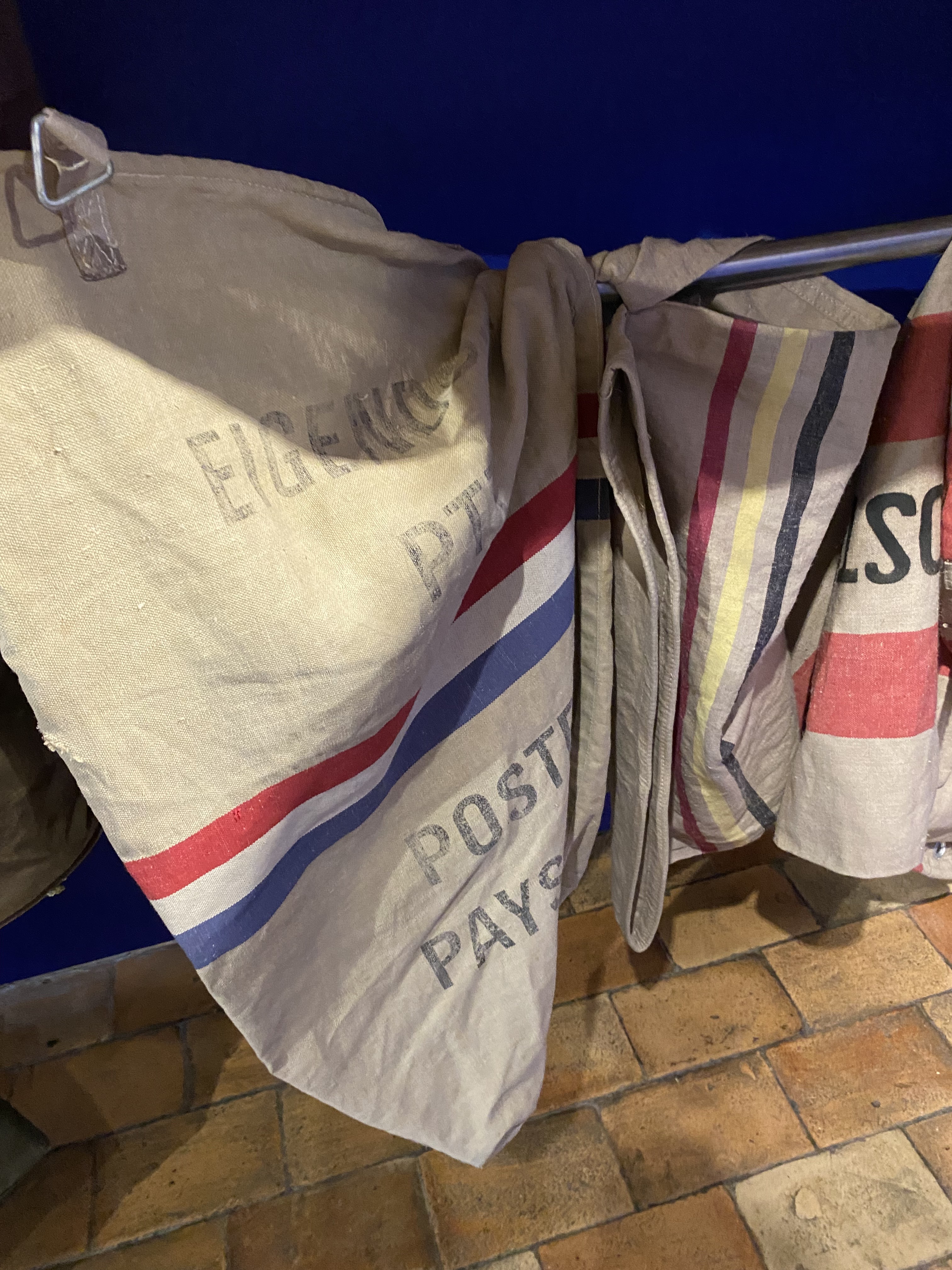
Postal bags made of flax


A belt


Lace bobbin


Spinning wheel


From the third floor


My linen bobbin, made in Belgium. They had white as well, but I plan to use it when I'll make another hemp blouse.

Normally I would say to go on my Instagram @mademoiselle.ralu but lately all the changes that the platform is putting in place are not to my liking. I don't have tone of time to spend there either, so...we'll see.